Public Health Team
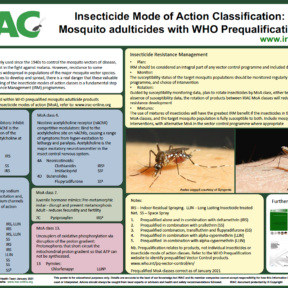
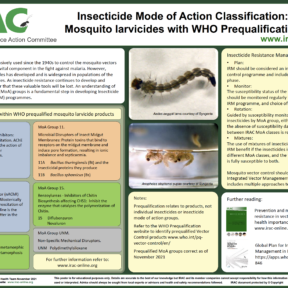
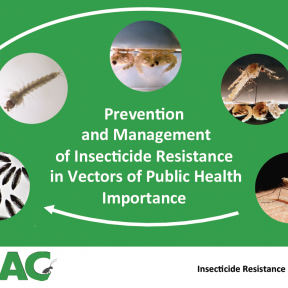
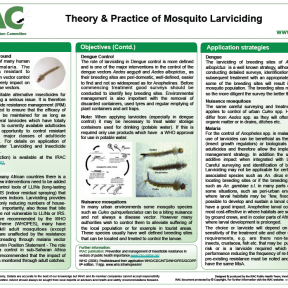
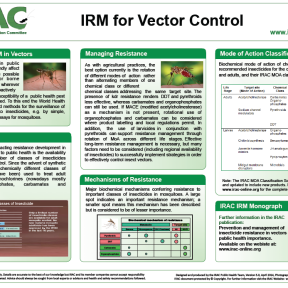
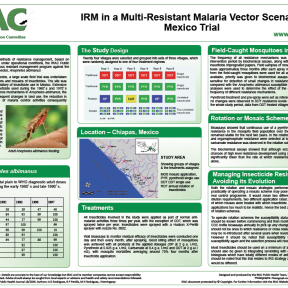
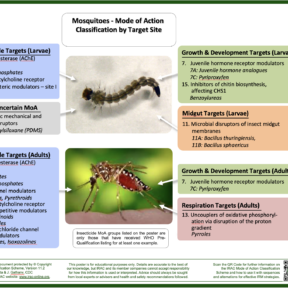
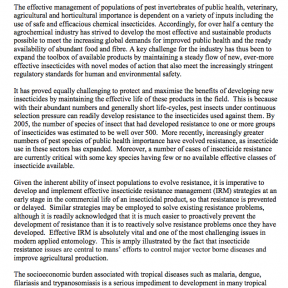
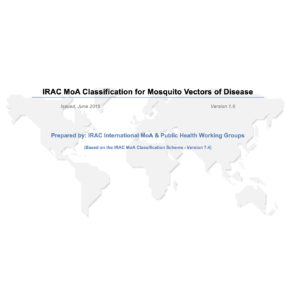
The Public Health Team was formed in 2006 to continue the work initiated by the previous IRAC Vector Team and has the extended remit covering hygiene pests as well as vectors. Most of the efforts have focused on forming links with key groups working in the vector control area (WHO, Bill and Melinda Gates Foundation BMGF and Innovative Vector Control Consortium IVCC). A key IRAC publication “Prevention and Management of Insecticide Resistance in Vectors and Pests of Public Health Importance” was first published with inputs from these groups in 2007 and an updated second edition was published in 2010. A mini-version of this comprehensive booklet was published in 2011.
Team Objectives
- Identify potential, new or existing resistance issues. Set up Team Working Groups or Focal Points as necessary
- Provide expert input into IRM initiatives with identified partners, interact with groups working in the same field and participate/organise relevant meetings.
- Formulate the IRAC position on ongoing questions and issues as these arise
- Preparation of Public Health communication material
WHO Test Methods and associated information
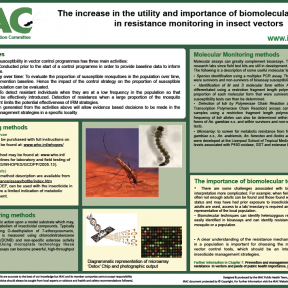
- WHO test procedures for insecticide resistance monitoring in malaria vectors
- Discriminating concentrations of insecticides for adult mosquitoes
- Supplies for monitoring insecticide resistance and procurement of WHO test kits
CDC Vector resistance Assays:
- Bottle Bioassay
- Larval Bioassay
- Bottle/Beaker Calibration
- Microplate Assay
- Establishing the Diagnostic Dosage
CropLife Intl. – Information on Public Health and Vector Control
The Resistant Mosquito: Staying Ahead of the Game in the Fight against Malaria – Training Course
Discover approaches and advances in our fight against the malaria mosquito using Insecticide Resistance Management (IRM). This course is designed for anyone involved in mosquito vector control as well as students and scholars of Public Health, One Health, Entomology, Epidemiology, or Evolutionary Biology. It will also appeal to the general public interested in malaria elimination, vector-borne diseases and mosquito control, and those with a wider interest in insecticide resistance management.
The RBM VCWG is proud to announce that this free course will start on Monday July 25th, and registration is now open via this link